Tiny house vs steel house: it is one of the most common questions we hear from people planning a new home, a holiday retreat or extra living space on family land. Both options are built largely in a factory, both are quicker than conventional masonry construction and both can be genuinely comfortable. Yet they suit quite different lives.
A tiny home puts everything you need into a compact, transportable footprint. A steel house is a full-size home on a foundation, planned around your family and your plot. The right choice depends on how much space you need, how long you plan to stay, your site and your budget.
In this guide we compare the two point by point, using real models from our range at TSD Çelik Yapı in Gaziantep, Turkey, so the trade-offs are concrete rather than abstract.
What we mean by a tiny home and a steel house
Definitions vary between manufacturers. In the wider market, many tiny homes are timber-framed and some are built on towable trailers. At TSD Çelik Yapı, our tiny homes are transportable modular units with a steel structure. They leave the factory finished and are placed on site, where only the electricity and water connections are made.
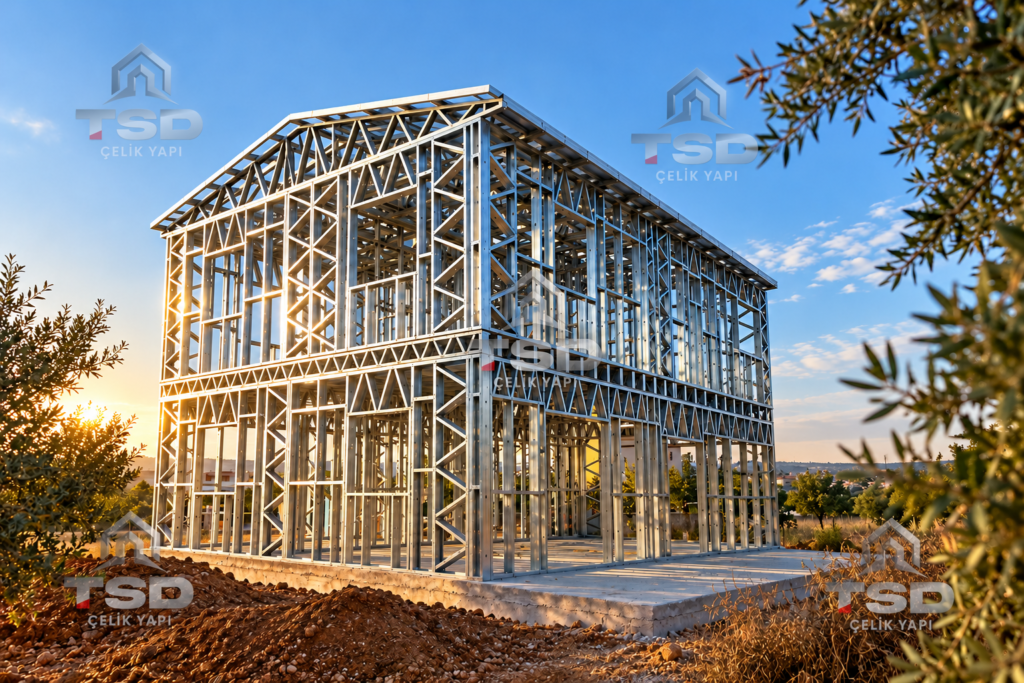
Our steel houses are permanent buildings erected on a foundation. Their light steel frame is produced in our factory to the project design, then assembled on site, where walls, roof and insulation are completed and the interior is finished.
So in our case the comparison is not steel against wood. It is a compact, transportable home against a full-size permanent house, both built in steel. If you want the material question too, see Steel Frame House vs Wood: Strengths and Trade-offs.
- Tiny homes in our range: Sirius 30, Eco Laguna 30 and Valora 30 (30 m²), Mondera and Tiny Terra (40 m²), Delta42 (42 m²) and Aura 60 (60 m² from two modules).
- Steel houses in our range: Cihan 80 (60 m² enclosed plus a 20 m² veranda), single-storey houses of 90 m² and 120 m², a 140 m² two-storey house, a 160 m² two-storey villa, Skyline 65 and the Üçgen Villa.
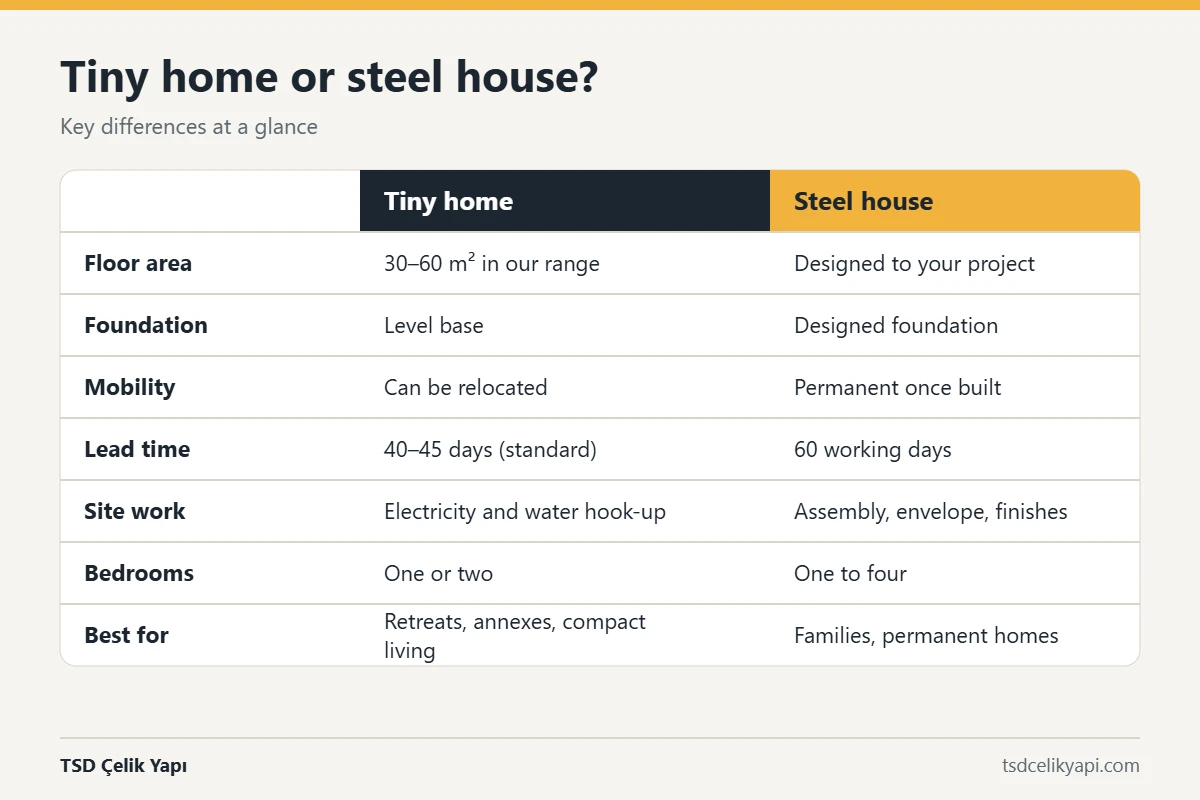
Tiny house vs steel house at a glance
| Criterion | Tiny home (transportable) | Steel house (fixed) |
|---|---|---|
| Size in our range | 30 to 60 m² | Designed to the project, up to 160 m² in our standard models |
| Foundation | Placed on a suitable, level base | Built on a foundation designed for the plot |
| Mobility | Can be relocated | Permanent once built |
| Delivery lead time | 40 to 45 days for standard models | 60 working days under the contract |
| Work on site | Electricity and water connections | Foundation, assembly, envelope and finishes |
| Bedrooms | One or two | One to four, or as designed |
| Typical use | Retreats, annexes, rentals, compact living | Family homes, permanent residences, villas |
Mobility and site flexibility
This is the clearest difference. A transportable tiny home can be moved to another plot if your plans change, which suits people who lease land, expect to relocate or want a home that can follow them.
A steel house is designed to stay put. Light steel buildings can in principle be dismantled and re-erected, because their elements are bolted and screwed together, but for a larger house that is a major project needing careful planning, transport and a new foundation. If mobility is a real requirement, choose a transportable model from the outset.
Site access works the other way round. A tiny home arrives in one piece, so the route must allow a large vehicle and lifting equipment to reach the placement point. A steel house arrives as numbered elements, which is often easier on tight or remote sites.
Build time and installation
Both formats avoid the long wet stages of masonry construction: no formwork, plastering, screed or waiting for materials to dry. The difference lies in how much happens on site.
Our standard transportable models have a delivery lead time of 40 to 45 days. They are shipped turnkey, so once the home is in position it only needs connecting to electricity and water.
Fixed steel houses are completed within 60 working days under the contract. As a typical guide from our experience, factory production of the steel elements takes 5 to 15 days, site assembly of a small single-storey house of 40 to 60 m² takes 7 to 10 days, and a two-storey villa takes 20 to 30 days. Foundations and site preparation come before that, and timings always depend on the project.
Space, comfort and family life
A tiny home rewards a minimalist lifestyle. At 30 m², a model such as the Sirius 30 gives you a 12 m² living-kitchen, an 8 m² bedroom and a 3 m² bathroom. That is plenty for one person or a couple, but every item you own needs a place.
Our larger transportable models stretch the format. The Mondera has 40 m² with a 2.70 m internal height, while Delta42 and Aura 60 offer two bedrooms for a small family.
A steel house can be designed at the floor area and number of storeys you need, and it feels like a conventional home. The Cihan 80 combines 60 m² of enclosed space with a 20 m² veranda, while our 140 m² two-storey house has three bedrooms, three bathrooms, a terrace and a balcony. For a growing family or a long-term home, that extra space is hard to replace.

Structure, durability and maintenance
Many tiny homes on the market are timber-framed, which needs good protection against moisture, rot and insects. Ours are not: both formats use galvanised steel.
- Tiny homes: a hybrid structure with heavy steel for the chassis, columns and beams, and S280-grade light steel with Z100 galvanised coating for panels and secondary members. The heavy chassis is what allows the finished home to be lifted and transported.
- Steel houses: a light steel frame of first-quality S280 steel with Z100 galvanised coating, dimensioned for each project according to its structural design.
Steel does not rot, is not eaten by insects and does not shrink or warp. That said, no building is maintenance-free. Inspect the roof, gutters and facade at least once a year, repair any damaged coating promptly and keep water away from the structure. Good detailing and regular care are what give either format a long life.
Insulation and energy efficiency
A small home is quick to heat, but it has a lot of external surface relative to its floor area, so the quality of the envelope matters just as much as in a large house.
Our transportable models use 10 cm of stone wool in the walls, floor and roof, with moisture barriers, cement-based Boardex board, fibre cement cladding and thermally insulated aluminium windows with tempered reflective glass.
Our fixed steel houses have a 14 cm steel panel wall with 10 cm of stone wool, 12.5 mm Boardex, a moisture barrier, insulated window reveals and JOTUN silicone facade paint, plus 10 cm of glass wool in the ceiling and 4+12+4 double glazing. The thicker wall build-up and the option to design the insulation level per project make a steel house well suited to permanent, year-round living. In both cases, steel conducts heat, so thermal bridges at junctions must be handled carefully.
Costs, planning and paperwork
We do not publish prices, as every project is quoted individually. In general, a tiny home needs a smaller overall budget simply because it is smaller. The cost per square metre is not necessarily lower, though, because kitchens, bathrooms and services are concentrated in a small area.
For both formats the price depends on floor area and number of storeys, plan, roof and cladding, insulation level, windows and interior materials, structural system and steel thickness, and foundation, transport, assembly and site conditions.
Planning rules are a separate question. A steel house is generally treated much like any other new dwelling, while the position of a tiny home can depend on its use, placement and how long it stays. Rules differ between countries and councils, so check with your local planning authority before you commit to either option.
Which one fits you?
A tiny home is likely to suit you if:
- you live alone or as a couple, or need a guest annexe, holiday let or retreat;
- you may want to move the home to another plot later;
- you want the shortest route from order to moving in;
- you are happy with a compact, well-organised plan.
A steel house is likely to suit you if:
- you need three or more bedrooms, or expect your household to grow;
- you are building a permanent home on your own land;
- you want a plan designed around your plot, with one or two storeys;
- you value the space and storage of a conventional house.
Still unsure? Our checklist Buying a Tiny Home: 10 Things to Check Before You Order will help you test whether the compact route works for you.
How TSD Çelik Yapı builds both
We manufacture both formats in our own facility in Gaziantep and manage the whole project ourselves, in five steps: design, production, shipment, assembly and turnkey handover. Profiles are cut and punched on computer-controlled machines using CNC cutting and roll-forming, and steel house elements are numbered and ready to assemble.
Explore our steel houses or browse all models, including tiny homes, on our projects page.
Tiny house vs steel house: frequently asked questions
Is a tiny home cheaper than a steel house?
A tiny home usually needs a smaller overall budget because it is smaller, but the cost per square metre is not necessarily lower. Prices depend on the specification and scope, so both are quoted per project.
Can a family live in a tiny home?
A couple or a small family can, especially in a two-bedroom model such as Delta42 or Aura 60. For three or more bedrooms and room to grow, a steel house is usually the better fit.
Are TSD tiny homes made of steel too?
Yes. Our transportable tiny homes use a hybrid structure with a heavy steel chassis, columns and beams, and S280 light steel with Z100 galvanised coating for panels and secondary members.
Can a steel house be moved later?
A steel house on a foundation is designed to stay where it is. Light steel structures can in principle be dismantled and re-erected, but for larger homes this is a substantial project, so choose a transportable model if mobility matters.
Which is faster to deliver, a tiny home or a steel house?
At TSD, standard transportable models have a delivery lead time of 40 to 45 days, while fixed steel houses are completed within 60 working days under the contract. A tiny home also needs far less work on site.
Do I need planning permission for either option?
Often yes for a steel house, and possibly for a tiny home depending on its use and placement. Rules differ by country and council, so confirm with your local planning authority before you order.
Conclusion: choose the format that fits your life
The tiny house vs steel house decision is less about which is better and more about which fits. Choose a tiny home for compact, flexible living with minimal site work; choose a steel house for space, permanence and a plan built around your family.
Tell us how many people will live in the home, where it will stand and how you plan to use it, and we will suggest the right model. Call or WhatsApp +90 532 459 19 27, email export@tsdcelikyapi.com or visit our contact page.